Loading product...
Arduino
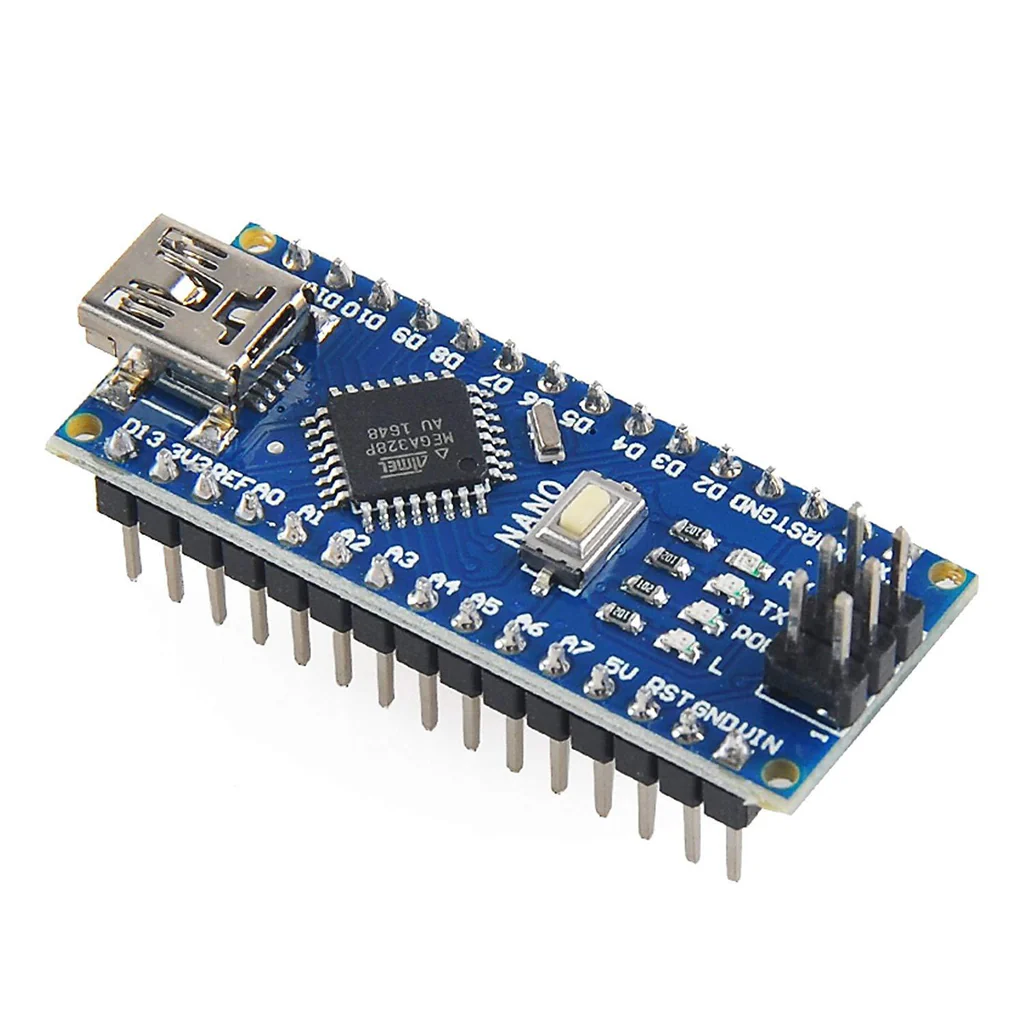
Arduino Nano V3.0 Compatible Clone (CH340G)
★★★★★
0.0/5 (0 reviews)₹699
The Arduino Nano Clone is a small, complete, and breadboard-friendly board based on the ATmega328P. It is a mechanical necessity for compact robotics, wearable tech, and multi-sensor arrays, offering the same processing power as an Arduino Uno but in a significantly smaller footprint. Most clones utilize the CH340G USB-to-Serial chip to maintain affordability, making it the top-rated choice for educational kits and mass-produced prototypes that require reliable.
✓ In Stock (44 available)
1
▪Breadboard-Friendly Design: The Nano Clone is a mechanical necessity because its dual-inline pin headers allow it to plug directly into a breadboard, eliminating the mess of jumper wires during the prototyping phase.
▪Dual Power Flexibility: Can be powered via the USB connection or an external 6V-12V unregulated power supply through the VIN pin, a mechanical necessity for battery-operated field deployments.
▪Identical Code Compatibility: Since it uses the same ATmega328P chip, it is a mechanical necessity for seamless migration—any code written for an original Arduino Uno or Nano will run perfectly on this clone.
▪Integrated CH340G Serial Bridge: While it requires a specific driver, this chip is a mechanical necessity for lowering the total cost of the board while maintaining high-speed data transfer to your PC.
▪Extra Analog Inputs: With 8 analog pins (A0-A7), it is a mechanical necessity for projects requiring more sensor data than the standard Uno (which only has 6).
Microcontroller
ATmega328P (8-bit AVR).
Operating Voltage
5V
Input Voltage (Recommended)
7V to 12V.
Digital I/O Pins
14 (6 provide PWM output).
Analog Input Pins
8 (2 more than the Uno).
Flash Memory
32 KB (2 KB used by bootloader).
SRAM / EEPROM
2 KB / 1 KB.
Clock Speed
16 MHz.